

Introduction
Manufacturing efficiency in discrete operations depends heavily on accurate data capture, classification, and real-time measurement of performance metrics such as OEE (Overall Equipment Effectiveness). However, inconsistent data capture, manual interventions, and unreliable PLC logic often lead to incorrect insights, masking true efficiency and impacting decision-making. This case study highlights how an AI–IIoT–enabled framework was conceptualized to address these challenges. By improving data accuracy, automating classification, and standardizing implementation across plants, the organization aimed to unlock true production visibility and operational efficiency.
Customer
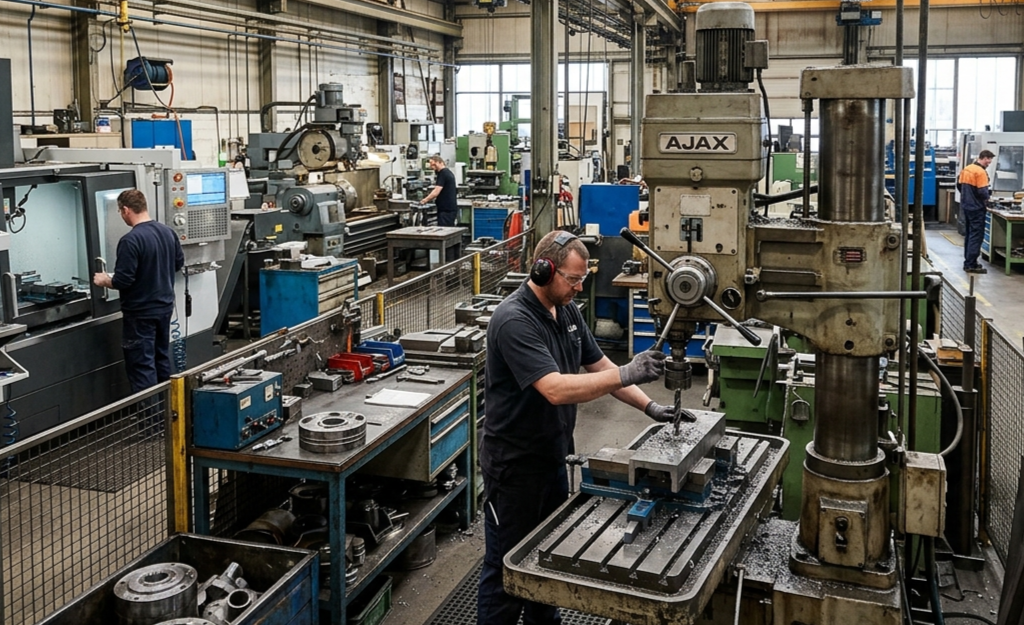
A manufacturing organization with operations across forging, drilling, and injection moulding processes, facing challenges in efficiency measurement, data capture, and workforce usability.
Business Objective
- Improve accuracy of downtime vs. changeover classification
- Enable reliable rejection and rework data capture
- Enhance production efficiency measurement beyond planned vs. achieved metrics
- Strengthen PLC/IoT-based data capture for manual operations
- Standardize IoT implementation across plants
Scope of Services
- Design of AI–IIoT–enabled framework for manufacturing operations
- Automation of downtime and changeover classification
- Enablement of conditional rejection and rework data handling
- Implementation of advanced efficiency metrics beyond basic production tracking
- Enhancement of PLC/IoT logic with anomaly detection
- Standardization of IoT data capture across multiple plants
Key Challenges Addressed
- Misclassification of downtime vs. changeover due to flawed timestamp logic
- Delayed and inaccurate rejection/rework data entry
- Misleading efficiency metrics masking real production performance
- Inconsistent pulse capture in manual drilling operations
- Fragmented IoT adoption across different manufacturing units
Benefits
- Accurate classification of production events and improved OEE visibility
- Reduced dependency on manual data entry and intervention
- Improved quality data accuracy for rejection and rework analysis
- Better alignment of efficiency metrics with real production performance
- Standardized and scalable IoT implementation across plants
Impact
- Improved production accuracy and operational visibility
- Enhanced workforce usability and reduced manual intervention
- Better decision-making through reliable efficiency metrics
- Foundation for scalable AI–IIoT adoption in discrete manufacturing environments